Tuesday, July 30, 2019

That old 'strange magic' music still sounds new as Jeff Lynne’s ELO enchants Chicago


 By Tom Siebert

When Jeff Lynne founded the Electric Light Orchestra in 1970, his musical vision was to pick up where the recently disbanded Beatles had left off.

Nearly 50 years later, the legendary Lynne showed more than 20,000 fans at the United Center that his dazzling, dizzying songs still sound light years ahead of most music played before or since then.

The symphonic rock band opened the Chicago show of their 2019 North American tour with the orchestral “Standin’ In The Rain,” from ELO’s mega-selling 1977 double-album “Out of the Blue.”

The somewhat obscure song was elevated to stunning stature, with brilliant laser lights shooting across the sports arena and colorful images of rain, clouds, and lightning projected across five Stonehenge-like video screens.

But the music alone quickly stole center stage during the opening of the second song, as Mr. Lynne sang some familiar lines that thrilled and chilled the crowd:

“You made a fool of me. But them broken dreams have got to end.”

As if on cue, the audience joyfully rose up and clapped to the hypnotic piano groove of “Evil Woman,” the smash hit from 1975’s “Face the Music” album.

“Hello, Chicago!” Mr. Lynne shouted out to the cheering Baby Boomer-heavy audience. “You seem to be in good spirits tonight.”

Those spirits were lifted higher and higher throughout the nearly two-hour musical feast that featured some of the most sophisticated songs ever written and arranged––accompanied by a kaleidoscopic video and laser-light show that depicted and danced along with the perfectly performed music.

The 12-piece band played and sang lush, lively versions of  the irresistible sing-alongs “Do Ya” and “Livin’ Thing,” as well as the playful “Turn To Stone” and the beautifully bittersweet “Can’t Get It Out Of My Head,” on which Mr. Lynne paid homage to the late John Lennon’s serrated singing voice.

ELO’s music has always been futuristic but fun too. During the thunderous “Don’t Bring Me Down,” from 1979’s “Discovery” LP, the crowd delighted in shouting the name “Bruce!” following the title line.

And has there ever been a more entertaining tune than 1977’s “Mr. Blue Sky,” with its  bending guitar solo, cello chorus stop, and more cowbell than Christopher Walken could ever want?

The inventive songs of the Electric Light Orchestra dominated Top 40 radio in the 1970s and are now a staple of classic rock stations. The progressive rock band went through revolving-door personnel changes, with Lynne now its sole original member.

But the current ELO lineup is as good and gifted as any of the group’s previous iterations.

They are Mike Stevens, musical director, guitar, and backing vocals; Milton McDonald, lead guitar, backing vocals; Lee Pomeroy, bass guitar, backing vocals; Iain Hornal, guitar, vocals; Melanie Lewis-McDonald, backing vocals; Marcus Byrne, piano, keyboards; Jo Webb, keyboards; Steve Turner, keyboards; Donavan Hepburn, drums; Jessie Murphy, violin; and celloists Amy Langley and Jess Cox.

And besides, for many years there was no version of ELO either recording or touring. That gave Mr. Lynne time to perform his studio wizardry, producing Tom Petty’s masterpiece “Full Moon Fever” in 1989, and the surviving Beatles’ reunion songs “Free As A Bird” and “Real Love” for their “Anthology” TV special/album in 1995.

Oh, and in 1988, Jeff joined a short-lived band that had a lot of potential, the Traveling Wilburys, whose other members were named Bob Dylan, Roy Orbison, the aforementioned Mr. Petty, and George Harrison.

The late Beatles’ son, Dhani Harrison, was the opening act at the United Center rock extravaganza. He can’t help that he looks and sounds like his famous dad. But the younger Harrison is a fine performer in his own right, deftly playing rhythm guitar and leading a taut five-piece band whose songs ranged from progressive rock to melancholy blues to Beatlesesque psychedelia.

Dhani was brought back on stage during the main show to sing some of the clever verses from the Wilburys’ 1988 hit “Handle With Care,” a world-wise song that brought tears to some in the audience as iconic photos of the late Messrs. Orbison, Harrison, and Petty were displayed on the massive video screens.

Jeff Lynne is a genius and a gentleman, a self-effacing guitar hero whose voice can still reach the high notes of ELO’s operatic songs.

The evening’s encore was fittingly “Roll Over Beethoven,” which opens with the master composer’s dramatic first movement from his fabled “Fifth Symphony,” heady stuff for the pop music world of 1973 when the hit single was featured on the album “ELO 2.”

The classic song was written by Chuck Berry, who invented rock ‘n’ roll, and in recent years led a sad procession of music giants who have left us, including David Bowie, Tom Petty, and Glenn Frey of The Eagles.

All of which makes Jeff Lynne’s ELO even more of a treasure and pleasure to see, feel, and hear in concert.


Saturday, June 22, 2019

The Rolling Stones show Chicago that they're still rock's best band ever


By Tom Siebert

I have long known that Mick Jagger has a heart. The mega-rock star once sent my then-wife two dozen roses and secured us press seats for a Rolling Stones concert at Soldier Field in Chicago.

Today, Mick’s heart is making headlines around the world as the legendary Stones front man showed last night that he is fully recovered from cardiovascular surgery.

He sang, skipped, mugged, and mimed during a two-hour-plus show before more than 60,000 fans, again at the historic lakefront stadium, with the majestic Windy City skyline as his backdrop.

The rock titans tore into their opening number, “Street Fighting Man,” from the landmark 1968 album “Beggars Banquet,” as their animated lead singer triumphantly pranced and danced his way down a runway that jutted into the audience, demonstrating that he still has moves, well, like Jagger.

The roaring crowd gave him a heartfelt heaping of cheers, shouts, and fist salutes as the Stones kicked off their 2019 No Filter Tour of North America, three months after the first 14 dates were postponed while Mr. Jagger recovered from a heart-valve replacement.

The storied band was back together, and guitar heroes Keith Richards and Ron Wood––as well as genius drummer Charlie Watts­­­­­­––could not contain their joy, in an emotional performance of still-stunning songs that changed the course of music and culture.

Starting up with "Street Fighting Man" was the Stones sticking their tongues out at the Chicago radio stations that refused to play the single, after demonstrators protesting the 1968 Democratic National Convention clashed with police at nearby Grant Park.

The second number was 1967’s “Let’s Spend the Night Together,” a once-controversial Stones tune that now seemed like just an enjoy-the-evening invitation to the cross-sectional audience that spanned four generations.

“It feels pretty good,” Mr. Jagger told the enthusiastic crowd, only coyly referring to his recent health problems. “We love Chicago so much we decided to start the tour here instead of Miami.”

But it was altogether fitting that the Rolling Stones should be born again in the city that gave birth to them, when schoolmates Mick and Keith met on a train in Dartford, England, in 1961, discovering their mutual love of Chicago blues artists like Muddy Waters and Howling Wolf.

It was hard not to think of that unassuming meeting as the self-described Glimmer Twins, now in the biggest band ever, strummed acoustic guitars and sang harmony during the country satire “Dead Flowers,” from their monster hit album, 1971’s “Sticky Fingers.”

Friday night was the 38th time that they have played in the Chicago area, and the local fans, like those all over the globe, seemed to know the words to most of their songs.

But the official sing-along of the Soldier Field concert was the epic “You Can’t Always Get What You Want,” with Mick thrusting his microphone at the crowd during the chorus and Mr. Wood performing a brilliantly beautiful guitar solo.

The Stones, who were once called “the bad boys of rock and roll,” are now grandfathers. Mick and Keith, who used to drink Old Grandad whiskey on stage, now get their satisfaction from bottled water.

The showstopper of the night was “Sympathy For The Devil,” whose opening primitive drumbeat was accentuated by a hellscape of real smoke emanating from the massive stage and fake fire burning on the giant video screens, while Mick and the crowd screamed “wooh wooh” in unison.

The samba-tinged song took on mythic significance after the Stones performed it during an ill-fated free concert at the Altamont Speedway near San Francisco on Dec. 6, 1969, when Hells Angels fought with hippies and four people died, including a young black man, Meredith Hunter, who was stabbed to death.

But “Sympathy” is more historic than satanic, as it chronicles some of the worst atrocities of the 20th century. It is also illustrative of the literate lyrics of Mr. Jagger, who was a history major at the prestigious London School of Economics.

“I watched with glee while your kings and queens fought for ten decades for the gods they made,” he sang in a sparkly red shirt and tight black jeans. “I shouted out, ‘Who killed the Kennedys?’ when after all, it was you and me.”

Bass player Darryl Jones, who is an indispensable member of the Stones, was spotlighted during the haunting “Miss You,” from the Stones’ biggest-selling album, 1978’s “Some Girls.”

The band paid homage to Chicago blues with practically every number, but especially “Midnight Rambler,” a pulsating horror-show song from 1969’s classic “Let It Bleed” album, with Mick raucously playing a harmonica, while Keith and Ronnie traded distorted guitar grunges.

Mr. Richards, who has survived heroin addiction, drug busts, and brain surgery, was also warmly greeted by the Soldier Field fans, as he stood on the front stage to sing and play “Before They Make Me Run,” in which he wrote his own epitaph:

“After all is said and done, gotta move while it's still fun. Let me walk before they make me run.”

The eclectic crowd not only got what they wanted, they got what they needed: almost every one of the Stones’ classic rock standards including "Angie," “Jumping Jack Flash,” “Paint It Black,” “Start Me Up,” “Brown Sugar,” and “Honky Tonk Women,” which was performed in front of giant Picasso-meets-Andy Warhol females depicted colorfully on the jumbo stage screens.

The first encore was “Gimme Shelter,” a thunderous, earthquake of a song, whose chilling line “Rape, murder––it’s just a shot away,” was screamingly sung by Sasha Allen.

Ms. Allen led a stellar cast of backup musicians that included Chuck Leavell on keyboards and backing vocals; Karl Denson, saxophone; Tim Ries, saxophone, keyboards; Matt Clifford, keyboards, percussion, and French horn; and Bernard Fowler, percussion and backing vocals.

The finale was of course “Satisfaction,” the number one song of 1965 that propelled the English rock group to international acclaim.

A second show at Soldier Field, home of the Chicago Bears, is scheduled for Tuesday night. Then the tour will head across the continent with scheduled stops in Arizona, California, Canada, Colorado, Florida, Massachusetts, New Jersey, Pennsylvania, and Washington, D.C.––and maybe more dates added.

The No Filter Tour began in 2017 and has since grossed $238 million, with an attendance of more than 1.5 million concertgoers at 28 shows in the United Kingdom and the rest of Europe.

The Rolling Stones have racked up those kinds of stratospheric receipts many times during their decades-long career.

But even if you had never heard of them or their songs, you would have still walked out of Soldier Field on Friday night knowing that you had just seen the greatest rock and roll band in the world.

Tuesday, June 11, 2019

New documentary 'Emanuel' shows how faith and forgivness healed survivors of Charleston church shooting


By Tom Siebert

Gun massacres are a common occurrence in American life. During this year alone in the United States, there have been more than 150 shootings that caused four or more casualties, according to the nonprofit Gun Violence Archive.

When a mass shooter strikes a place of worship, however, the bullets emotionally pierce not only our hearts and minds, but ricochet straight through to our souls.

Such was the tragic case on the evening of June 17, 2015, when 21-year-old white supremacist Dylann Roof walked into Emanuel African Methodist Episcopal (AME) Church in Charleston, S.C., sat through a Bible study, then pulled out a .45-caliber semiautomatic handgun and shot to death nine black worshipers as they stood up to pray.

Last night Wheaton College hosted a screening of a brilliant new documentary about the Charleston massacre, titled "Emanuel," before an audience of more than 100 people that included students, church leaders, and members of the community.

In the film, one of the three shooting survivors describes the horrific crime. "We closed our eyes to pray," said Polly Sheppard solemnly. "That's when he lit up the room."

Another survivor, Felicia Sanders, recounts speaking to the shooter in the midst of his killing spree: "When he spoke to me, I was on the floor looking up at him from under the table. He just stopped and he said, 'Did  I shoot you yet?' And I said, 'No.' And he said, 'I'm not going to. I'm going to leave you here to tell the story."'

Ms. Sanders also tearfully recalled shielding her five-year-old granddaughter on the floor, saving the girl's life, while watching in vain as her son Tywanza was shot to death across the room. "I felt every bullet that went into him," she said, choking up.

Even more shocking than the shooting was the scene two days later when the mass murder suspect, wearing a gray-and-white jail jumpsuit as well as wrist and ankle shackles, appeared via video conference for a bail hearing in Charleston County court.

Some of the shooting survivors and victims' relatives showed up in court, where Chief Magistrate James "Skip" Gosnell, Jr., asked them if they wished to speak.

The film portrays this tense encounter with somber silhouettes of the speakers slowly moving across the screen as audio from the hearing is played.

Nadia Collier, daughter of the slain Ethel Lance, is heard saying to Mr. Roof: "I will never be able to hold her again, but I forgive you, and have mercy on your soul. You hurt me. You hurt a lot of people but God forgives you, and I forgive you."

Ms. Sanders told him: "We welcomed you Wednesday night in our Bible study. We enjoyed you. May God have mercy on you."

And Rev. Anthony Thompson, the pastor of a nearby church whose wife Myra was among those shot dead, tells the mass killer: "I forgive you. And my family forgives you. But we would like you to take this opportunity to repent. Repent. Confess. Give your life to the one who matters the most, Jesus Christ."

Filmed mostly inside the 203-year-old church, colloquially called "Mother Emanuel," and the homes of victims' relatives, the 75-minute, award-winning documentary was financially backed by Viola Davis, an Oscar-winning actress and South Carolina native; and superstar point guard Stephen Curry of the Golden State Warriors.

Director Brian Ivie ("The Drop Box") also employs the film-making technique called "cinema verite," using actual television footage that showed how the monstrous act turned downtown Charleston into a frantic, flooded mass of screaming police cars, TV news trucks, hurried EMS workers, and panicked onlookers.

In addition to reporting the terrible story in a raw, riveting way, Mr. Ivie manages to seamlessly weave into the narrative Charleston's sordid past as a slave port, South Carolina's history as the only one of the 13 colonies that had a majority black population, and Mother Emanuel's role in the civil rights movement.

The film also recounts Mr. Roof's history of hatred, which included a racist manifesto that he had written as well as photos of him waving a Confederate flag and posing before symbols of white supremacy. And he is chillingly shown entering the church on a side-door surveillance camera, his fanny pack concealing his weapon of mass destruction.

The Confederate battle banner, long a source of controversy in Southern cities such as Charleston, was removed from the grounds of the South Carolina State House within three weeks of the tragedy. Then-Gov. Nikki Haley skillfully negotiated the move with state legislators and local guardians of Civil War culture.

Mr. Roof was convicted of mass murder and hate crimes, and is now awaiting execution. He had hoped to spark a national race war, the FBI stated.

But Charleston remained calm in the aftermath of the shootings, thanks to the forgiving sentiments of the survivors, calming words of city leaders, prayer vigils of activist groups like Black Lives Matter, and presence of President Barack Obama, who led mourners in the singing of "Amazing Grace" at the funeral of the church's prominent pastor.

Most of all, the documentary honors the so-called "Charleston Nine." They were: State Sen. Clementa C. Pinckney, 41, and pastor of Mother Emanuel; Cynthia Marie Graham Hurd, 54, manager of the Charleston County Public Library system; Susie Jackson, 87, a member of the church choir; Ethel Lee Lance, 70, the church sexton; Depayne Middleton-Doctor, 49, a pastor and admissions coordinator at Southern Wesleyan University; Tywanza Sanders, 26, a member of the Bible study and grandnephew of fellow shooting victim Susie Jackson; Daniel L. Simmons, 74, a pastor who served at Greater Zion AME church in nearby Awendaw; Sharonda Coleman-Singleton, 45, a pastor, speech therapist, and track coach at Goose Creek High School; and Myra Thompson, 59, a Bible study teacher.

Perhaps the most poignant scene in the movie was the interview with Myra's husband, Rev. Thompson, in the garden that he built for his late wife behind the church. The reverend recollected not being able to touch his spouse earlier on the day she died because "God already had her." 

The film screening was followed by a question and answer session that included Rev. Sharon Risher, whose mother, two cousins, and a friend were killed in the gun tragedy. Rev. Risher said that forgiveness did not come quickly for her. "It took me two years. I was angry at God. I argued with him."

She is the author of  "For Such a Time as This: Hope and Forgiveness after the Charleston Massacre," in addition to being the spokesperson for both the Everytown Survivor Network and Moms Demand Action for Gun Sense in America.

Others on the panel were the Rev. Dr. Rob Schenck, president of the Dietrich Bonhoeffer Institute, and Dr. Jamie Aten, founder of the Humanitarian Disaster Institute.

Rev. Schenk, who ministers to elected officials in Washington, D.C., told the audience that "the church has a role to play" in the prevention of gun violence. And Dr. Aten, a psychologist, said that he was called upon to comfort the loved ones of the five workers killed and six police officers injured in the mass shooting at a manufacturing plant in Aurora last February.

Pastor Sharon noted that the Charleston shooter should not have been able to legally buy his gun, since he had been arrested four months earlier on a felony drug charge.

She asserted that mental health screenings should be included in background checks for gun purchases, and further questioned the need for assault weapons as well as the seven ammunition magazines that Mr. Roof carried with him into the church.

During the six-minute shooting, he reloaded his weapon five times with large hollow-point bullets, according to police reports.

Also appearing at the Wheaton College screening was the film's producer, John Shepherd, a Glen Ellyn native who now lives in Santa Monica, Calif. Mr. Shepherd, who has many acting and producing credits, said, "We need to start a national dialogue about gun violence."

"Emanuel" is an uplifting lesson about how to forgive the next mass shooter. But it does not tell us how to stop him. Moreover, it is too late to prevent another Charleston. Since the Mother Emanuel shootings, some of the worst gun massacres in U.S. history have occurred.

Later in 2015, 14 people were shot to death at a social services building in San Bernardino, Calif.; 49 at a nightclub in Orlando, Fla., in 2016; 27 at the First Baptist Church in Sutherland Springs, Tex., in 2017; a record 59 at a country music concert in Las Vegas, later in 2017; 17 at Marjory Stoneman Douglas High School in Parkland, Fla., in 2018; 11 at the Tree of Life synagogue in Pittsburgh, also in 2018; 12 at a bar and grill in Thousand Oaks, Calif., again in 2018; and 11 at a public works building in Virginia Beach, Va., 17 days ago.

Since 1963, nearly 1.7 million people have died from shootings in America, according to the U.S. Centers for Disease Control and Prevention (CDC). Among those shot to death were President John F. Kennedy; civil-rights leader Martin Luther King, Jr.; Senator Robert F. Kennedy of New York; and singer-songwriter John Lennon of The Beatles.

"Emanuel" will break your heart in a million tiny pieces. But the grace and goodness of the survivors will painstakingly put it back together and restore your hope for humanity.

The film will be shown nationwide in selected theaters on June 17 and June 19, the anniversaries of the shootings and court hearing, respectively.

Mr. Shepherd said that Academy Award-winning actress Charlize Theron and multiple Grammy winners Stevie Wonder and Justin Timberlake have paid in advance for two-week showings of  "Emanuel" in Los Angeles and Nashville.

The producers are currently looking for a distributor so the documentary can run longer in movie houses. They have pledged to donate all of the box-office profits to the victims' families. Those who wish to learn more about the film or contribute to the survivors fund may visit www.emanuelmovie.com.

Following the screening and discussion, Rev. Risher led the Wheaton College audience in prayer. She did not lower her eyes.

Friday, June 7, 2019

Karen Beyer, 'champion of human services," retiring as CEO of Ecker Center for Mental Health in Elgin

By Tom Siebert

Karen Beyer has a lot of abbreviations at the end of her name: CEO, MPA, MSW, and three MBAs. But her life’s work is spelled out in the improved lives of the many whom she has helped in her 53-year career in social services.

The chief executive officer of the Ecker Center for Mental Health in Elgin is retiring at the end of the month, and the homages to her are just beginning.

She was called a “champion of human services,” by Ecker board chairman Alan Kirk, in announcing a fundraising effort to ensure that members of the community facing mental health challenges will continue to receive services and support.

“In her honor, we have created the Karen Beyer Circle to acknowledge her distinguished career, the impact her work has had on our community, and to ensure that the Ecker Center will continue to provide services in the face of increasing financial challenges,” Mr. Kirk said.

Ms. Beyer began her career as a child caseworker, later serving as a therapist for Lutheran Social Services. After earning a master’s degree in social work from Loyola University, she became clinical director for the Family Service Association of the Greater Elgin Area.

She also worked for several years in private practice as a marital counselor, helping couples to resolve their differences and stay together, and if they couldn’t, preparing them for life after divorce.

In 1983, Ms. Beyer became clinical director of health and human services for Hoffman Estates. There she defended the right of privacy of a traumatized police officer in a landmark U.S. Supreme Court case, “Jaffee versus Redmond and the Village of Hoffman Estates.” She also was a pioneer for the advocacy of employee assistance programs.

After earning another master’s degree, this one in public administration from Roosevelt University, she was hired as executive director of The Larkin Center group homes in Elgin, where she increased fundraising and developed new programs.

She has served at the Ecker Center since 2000, helping steer the mental health facility through many challenges, such as the increasing number and needs of its clients as well as working within the guidelines of the 2010 Patient Protection and Affordable Care Act, colloquially known as ObamaCare.

“Karen never gives up,” asserted Victoria Gesinger, assistant clinical director at the Ecker Center.

“She has led us through so many difficult financial crises with immense state budget cuts, and the more recent crisis where there was no budget at all.”

State Rep. Anna Moeller plans to introduce in the Illinois General Assembly a resolution honoring Ms. Beyer for her many contributions for the betterment of the community, according to Ecker’s events manager Karen LeBuhn.

For more information about the Ecker Center for Mental Health, visit eckercenter.org. All donations to the Karen Beyer Circle that are received by June 25 will be recognized on her final day of work before her retirement begins.

Added Ms. Gesinger: “We have been so fortunate to have a leader such as Karen to see us through these difficult situations with little impact to client care and employees.”

Friday, May 24, 2019

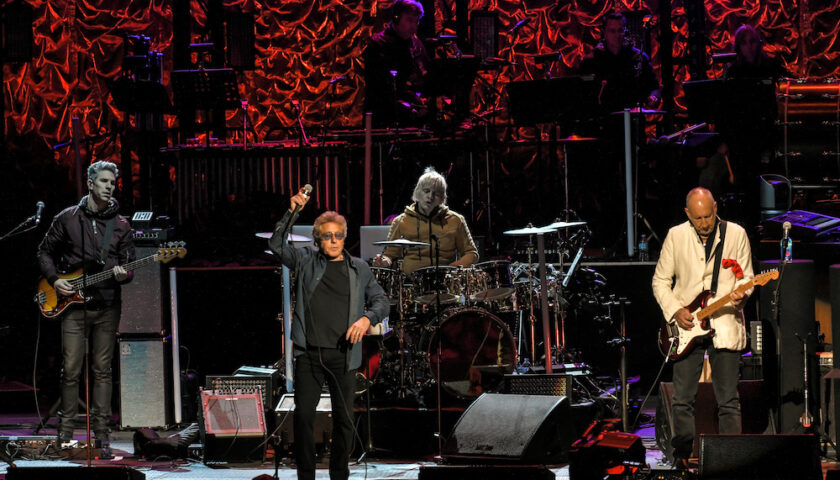
Meet the new Who––same as the old Who? Better, you bet!


By Tom Siebert

The Who don't do drugs anymore, their mad-genius drummer and brilliant bassist having sadly succumbed to overdoses in 1978 and 2002, respectively. And it has been decades since the visionary, explosive rock band closed their concerts by nihilistically destroying their instruments. 

But last night, a renewed Who elevated their storied songs to stratospheric heights before more than 25,000 fans at the Hollywood Casino Amphitheatre in Tinley Park, during the Chicago-area stop of their 31-date Moving On symphonic tour.

Rock giants Roger Daltrey and Peter Townshend fronted an astonishing musical assemblage comprised of their stellar seven-piece backing band and a magnificent 48-piece orchestra, some of them local musicians, conducted by Keith Levenson and arranged by David Campbell.

"Thanks for coming out tonight," Mr. Townshend said to the frozen people who braved 50-degree weather to see the fabled performers. "We'll try to warm things up a bit."

That they did. The first elegant eight songs were from 1969's "Tommy," The Who's groundbreaking rock opera about an emotionally and physically challenged boy who becomes a pinball wizard/pop guru.

Mr. Townshend, who turned 74 the other day, wrote the famed concept album to heal from his own childhood sexual abuse.

And the original guitar hero seemed to still be playing his instrument as a catharsis, hunching over it, attacking the strings, and flying his fingers up and down the frets--then standing survivor-tall with his trademark windmill power-strumming.

Mr. Daltrey, now 75 and a survivor himself of meningitis and throat cancer, sang the soaring refrain from "See Me, Feel Me, Touch Me" with vigor and vulnerability, pointing at members of the Tinley Park throng.

"Listening to you, I get the music. Gazing at you, I get the heat. Following you, I climb the mountain. I get excitement at your feet. Right behind you, I see the millions. On you, I see the glory. From you, I get opinions. From you, I get the story."

The delighted crowd got the story, the glory--and the lyrics right--singing along, smiling, and tearing up with emotion.

It was an eclectic audience that spanned at least three generations: Baby Boomers who perhaps first listened to Who albums in smoke-filled dorm rooms; their adult kids, who are all right; and younger aficionados, who were likely introduced to the band's iconic songs from the opening credits of TV's "CSI: Crime Scene Investigation" trilogy.

About 10,000 fans sat in the reserved seating section of the scenic outdoor amphitheater, while another 15,000 or so huddled on blankets or beach chairs in the sprawling lawn area, bathed in the sparkling colored lights streaming from the titanic stage.

The gifted orchestra somehow made violins sound like guitar solos and inserted majestic flourishes to The Who's writ-large songs with cellos, bassoons, French horns, a harp, and timpani.

After the "Tommy" set, the orchestra exited the stage, leaving the core band members to thrill the crowd with legendary rock standards.

Mr. Daltrey good-naturedly noted the cold wind blowing in his face and shouted out, "Don't you people know it's nearly summer?!"

His band mate of 55 years added: "We love Chicago. Everyone seems to be so warm and friendly, except the ones who aren't so warm and friendly--just like home."

The showstopper of the enchanted evening was a surprising acoustic rendition of "Won't Get Fooled Again," an epic song from 1971's classic "Who's Next" album.

The frigid fans, many of whom were dressed as if they were at a Chicago Bears game in mid-December, warmed up by standing, dancing, and chiming in word for word--including the song's cynical, lyrical conclusion about the political revolution of the late 1960s: "Meet the new boss! Same as the old boss!"

Mr. Daltrey, whose performing skills include singing, mike tossing, tambourine banging, and harmonica playing, donned an acoustic guitar and strummed credibly during "Eminence Front," a mesmerizing electronic funk from 1982's "It's Hard" album.

A violin-driven version of 1971's "Behind Blues Eyes" gave added drama and depth to the bittersweet ode to codependency.

Roger and Pete were joined together on stage by violinist Katie Jacoby, vocalist Billy Nichols, and regular band members Simon Townshend on guitar, Loren Gold on keyboards, Jon Button on bass, and drummer Zak Starkey--whose father, Ringo Starr, used to play with a little band called The Beatles.

The Who could not and did not perform all of their many greatest hits. I was disappointed that they did not do "You Better You Bet," a quirky love song whose ironic, yearning verses have been heard on rock radio since 1981.

But this was no loose "Freebird" type of concert. No, it was an immovable feast of precisely measured music that required exquisite timing among the 55 master musicians who often shared the stately stage.

The massive symphonic assault of the senses was at once thrilling and even more chilling than the Windy City weather.

Perhaps the most poignant moment of the night was achieved by just Pete and Roger dueting a pretty offering of "Tea & Theatre," from their 2006 album "Endless Wire."

"Two of us--we will have some tea," sang Mr. Daltrey, wearing a black down jacket and raising a cup of tea to Mr. Townshend as the moving ballad drew to a close.

Watching this emotional scene, I could not help but recall The Who's star-crossed history. As children, they played in the rubble of post-war Britain.

Mr. Townshend has said his melancholy lyrics and scorched-earth sounds grew out of his Cold War generation's growing up under the constant threat of nuclear annihilation.

Then, on Sept. 7, 1978, their comedic, dynamic drummer Keith Moon died in his London flat after consuming 32 tablets of clomethiazole, which had been prescribed to ease his alcohol withdrawal.

Many more losses came on December 3, 1979, when 11 young Who fans were stampeded to death prior to a concert at Riverfront Coliseum in Cincinnati. The horrific tragedy led to nationwide bans on festival seating, where the first to enter music venues got the spots closest to the stage.

And original member John Entwistle, who was voted the greatest bass player ever in a Rolling Stone magazine readers' polls, died at age 57 from a cocaine-induced heart attack in a hotel room in Paradise, Nevada, on June 27, 2002.

So the change, well, it had to come. Last week, Mr. Daltrey cussed out a fan in Nashville for lighting up a joint, saying that he was allergic to marijuana smoke and it adversely affected his voice. 

But through it all, the band played on, right up to last night's mega-gig at the Hollywood Casino Amphitheatre.

The third act of the two-and-a-half-hour, 24-song show featured orchestrated numbers from The Who's 1974 magnum opus, "Quadrophenia."

The highlight was that album's "Love Reign O'er Me," which began with a dramatic piano interlude by Mr. Gold and reached rock 'n' roll high heaven with Mr. Daltrey's up, up, and away wailing of the chorus line.

I attended The Who's allegedly final U.S. concert at the Los Angeles Coliseum in 1982. And if their lead singer has lost a step or note, I couldn't tell.

The same goes for Mr. Townshend. He seems to be ever exploring the sonic depths of his guitar. And they have a new CD coming out later this year.

The encore was the anthemic "Baba O'Riley (Teenage Wasteland)," propelled by Ms. Jacoby's stunning violin solo.

Most everyone yelled out on cue rock's most-famous last line, "They're all wasted!"

If you missed this once-in-a-lifetime performance, The Who will be destroying audiences at venues across the nation throughout the summer and fall, including a concert on September 8 at the Alpine Valley Music Theatre in Elkhorn, Wisconsin.

But wherever they play, from Woodstock to the Super Bowl to Tinley Park, The Who's still on first.


Friday, May 17, 2019

'Shark Tank' star Mark Cuban jaws about health and happiness at Judson University's World Leaders Forum in Elgin

By Tom Siebert

Billionaire investor Mark Cuban, who owns the Dallas Mavericks professional basketball team, took some bank shots at President Trump on Tuesday, but dribbled away from whether he will wage his own independent campaign for the White House.

Speaking before the World Leaders Forum at Judson University in Elgin, the star of ABC-TV's "Shark Tank" took stances on several simmering political issues but stopped short of announcing his own third-party candidacy for president.

"My legislative priority is to win a playoff game," Mr. Cuban quipped, referring to the Mavs' missing the NBA postseason for the past three years, and drawing laughs among the more than 400 people jammed into Herrick Chapel at the Christian college.


About his rags-to-riches journey, he said: "I'm just a grinder. I always have been. I didn't get a small, million-dollar loan from anybody."

That was an indirect reference to Mr. Trump's self-narrative about how his father lent him the money that launched his lucrative real-estate business, although a recent New York Times investigation concluded that the president's paternal assistance amounted to many more millions.

Mr. Cuban, who told CNBC last Tuesday that he was considering a presidential run, was interviewed by Mark Vargas, a 2004 Judson graduate, health-tech entrepreneur, conservative opinion writer, and former U.S. Department of Defense adviser on rebuilding war-ravaged economies through private and foreign investment.

The two Marks talked substantively about healthcare reform, gun control, income inequality, reaching diverse business markets, and even artificial intelligence (AI), which Mr. Cuban predicted will radically change the world's economy in the same way that computers, the internet, and social media did.

"Vladimir Putin thinks so," Mr. Vargas noted.

"I'd like to hear what Putin has to say about Helsinki," joked Mr. Cuban, alluding to the Finland summit in July 2018 when the Russian leader spoke privately for two hours with President Trump.

But most of the hour-long conversation focused on the guest's success story, which began with him selling garbage bags door to door at the age of 12.

"I was fired from a software store, living with five other guys, and feeling stressed and stuck," he recalled. "I wanted to control my destiny, and starting my own company was the only way to do that."

Mr. Cuban started several successful companies, including MicroSolutions, a computer consulting service that he sold in 1990 to CompuServe, and Broadcast.com, a sports radio website that was sold to Yahoo for $5.6 billion.

He elicited enthusiastic applause twice after asking the audience if they watched "Shark Tank," the long-running series that allows aspiring entrepreneurs to make business presentations to a panel of five investors that includes Lori Greiner, Robert Herjavec, and Kevin O'Leary.

And the reality-TV celebrity regaled the audience with impressions of two television characters from his youth, Fred Sanford of "Sanford and Son" and Sergeant Schultz from "Hogan's Heroes."

"I thought he was super funny," said Judson freshman Carista Richie, who is majoring in Christian ministry. "And very knowledgeable."

Graduate student Taylor Hilliard, who plans to work on his master's degree in biomedical services at the university this fall, was particularly interested when Mr. Cuban spoke about the prospect of AI leading to more-accurate health diagnoses.

"The focus of medicine should be on the patient, and I want to be a part of that," he asserted.

The World Leaders Forum resumes on October 8 when author, attorney, and diplomat Caroline Kennedy will be the keynote speaker at the Renaissance Schaumburg Convention Center.

The daughter of the late President John F. Kennedy will be interviewed by conservative commentator Eric Metaxas, host of a nationally syndicated radio show.

The format will be similar to last year's World Leaders Forum, which featured a lively but civil discussion between Democrat Howard Dean, the former governor of Vermont, and Republican Newt Gingrich, ex-speaker of the U.S. House of Representatives.

Previous keynote speakers at the forum were former President George W. Bush, ex-Secretary of State Condoleezza Rice, former Soviet Union leader Mikhail Gorbachev, ex-British Prime Minister Tony Blair, then-President Felipe Calderón of Mexico, and Her Majesty Queen Noor of Jordan.

To purchase tickets for the fall event, visit JudsonU.edu.

Located in Elgin since 1963, Judson University offers a Christian, liberal arts and sciences education through its bachelor of arts degrees for more than 60 majors, minors, graduate programs, and online, as well as certification and accelerated adult degree programs.

Proceeds from today's event support entrepreneurship and diversity scholarships for Judson students.

"My advice to students entering the workforce is that you don't need to find the perfect job right away," Mr. Cuban concluded. "Take that first job, find joy in the moment, approach it as a learning opportunity, and get smarter every day."


Friday, April 19, 2019

Movie 'The Public' mirrors the harsh realities of homelessness


By Tom Siebert
Assistant director for community relations
Public Action to Deliver Shelter (PADS) of Kendall County

For the past four years, I have had the high but humbling privilege of writing about the area's homeless community and those with huge hearts for helping them.

But for the grace of God, as well as the generosity of family and friends, I would be writing about homelessness in the first-person singular tense.

This issue hit home locally when Emilio Estevez--the writer, director, producer, and star of "The Public"--screened his new film last month to residents of Aurora's Hesed House, the second-largest homeless shelter in Illinois, at the Cinemark Tinseltown USA movie theater in North Aurora.

"The Public" is a bold, brilliant movie that touches on several hot-button topics of our time: policing, dirty politics, fake news, mental illness, the opioid crisis, and the occupy movements.

But this educating and entertaining film is mostly about the homeless, writ large and lengthily.
Mr. Estevez, who inherited the social conscience of his father, actor-activist Martin Sheen, demonstrates that when it comes to homelessness, he gets it--and gets it right.

For the past nine years, Kendall County PADS has been providing the local homeless with nutritious meals, overnight housing, and access to social services during the six colder months of the calendar.

"The Public" perfectly depicts the challenges that our PADS guests face on a day-to-day basis.

The film focuses on an eclectic group of about 100 homeless citizens who occupy the main Cincinnati library after closing hours, during a record-breaking cold night when all the city shelters are full.

Similarly, the public libraries in Oswego, Montgomery, and Yorkville are often havens for the homeless. They read books, newspapers, and magazines, in addition to using the computers to seek employment or connect with families or friends. And during the recent harsh winter, many area public buildings became warming centers.

In the movie, the homeless ride the Cincinnati Metro trains, sometimes with no particular place to go but to escape the cold.

In sprawling Kendall County, which has no public transportation, PADS partners with private transit firms to take guests to and from its seven shelter sites, and back and forth from their jobs for those who have them.

During two subfreezing nights last winter, Kendall Area Transit was forced to shut down. However, KAT kept its PADS routes open, so the guests would not have to walk in the big chill.

Citizens become homeless for myriad reasons that often overlap.

Some just lose their jobs like "The Public" character Smutts, played by Michael Douglas Hall.

Addiction is also a major factor, as personified in the movie by Jackson, actor Michael Kenneth Williams, who is shown openly drinking alcohol in the occupied library.

Others suffer from emotional challenges like Big George, poignantly portrayed in the film by Chicago rapper-philanthropist Che "Rhymefest" Smith.

At Kendall County PADS sites, social work interns from Aurora University help the homeless find employment, treatment options, 12-step programs, and permanent housing.

In "The Public," Mr. Estevez plays bleeding-heart librarian Stuart Goodson, who is reminiscent of Anne Engelhardt, the executive director of Kendall County PADS. Anne knows every shelter guest by name and need.

Mr. Goodson tries to give Jackson money and even gives Big George the eyeglasses off his face so that he can stop seeing "lasers" and see his way out of the sit-down situation.

Much of "The Public" centers on the police riot response to the library siege, with Alec Baldwin playing crisis negotiator Bill Ramstead, who is simultaneously searching for his own missing, opioid-addicted son among the homeless.

Locally, Kendall County law enforcement works closely with PADS. Sheriff Dwight Baird is a member of our board of directors.

Sheriff's deputies could arrest homeless citizens for vagrancy but they instead give them the choice to be taken to a PADS site. The sheriff's department also handles PADS' laundry, having it washed at the county jail.

In the movie, the TV news media wrongly reports that the peaceful demonstration is a hostage crisis. Members of the Cincinnati community bring bags and boxes of food to the area outside the sieged library.

That outpouring of kindness is matched here by the Kendall County Food Bank, which partners with PADS, as well as area residents who donate clothing, hygiene items, and other supplies to our sites at six churches and a Christian academy.

Finally, just as we are not shown the ultimate fate of the homeless in "The Public," we don't know where many of our PADS guests will go when the shelter season ends this Saturday.

The hope is they will find permanent places to live before the sites re-open in mid-October, but if they don't, Kendall County PADS will be there for them.

Thursday, April 11, 2019

'The Best of Enemies' is an inspiring movie about racial redemption

By Tom Siebert

It is the summer of 1971 in post-Civil Rights Act America. But many cities from Biloxi to Boston hadn’t yet gotten the memo that segregated schools were illegal, based on the landmark Brown versus Board of Education ruling by the U.S. Supreme Court in 1954.

One of those places is Durham, N.C., where an electrical fire badly damages an all-black elementary school, igniting a community furor over whether the displaced children would be allowed to attend classes in the same building as white students.

That is the true premise of “The Best of Enemies,” an edifying film that lengthily and arduously answers the innocent question that little Marilyn Atwater asks her single mother Ann: “Mommy, where are we going to go to school now?”

Ann Atwater was a battle-weary, tough-talking, black advocate. She was also a force of nature, and actress Taraji P. Henson’s portrayal of her is a tour de force that may earn her an Academy Award, one of the few acting honors she did not win for her stoic performance in the excellent “Hidden Figures.”


Ann first shows up in the movie pulling a phone receiver out of a city councilman’s hand in his office and hitting him in the head with it because he wasn’t listening to her. In a later scene she angrily turns around the swivel chair of a white councilman who had turned his back on her because she and her fellow fair-housing petitioners were black.

“What we’re talkin’ about is damn important and you gonna listen to us!” she shouts at the bespectacled, bewildered city lawmaker.

The U.S. civil rights movement was admirably led by a high-minded, silver-tongued orator, Dr. Martin Luther King, Jr. But it also needed down-to-earth “sistahs” such as “Roughhouse Annie” Atwater, as she was dubbed, to courageously clean up the primordial sleaze of institutionalized racism at the local level.

The astonishing untold story of “The Best of Enemies” is that the Ku Klux Klan, a domestic terrorist organization, was still infiltrating and influencing the civic and business life of cities like Durham as recently as the early ‘70s. To call the Klan a “white supremacist” group would be a misnomer because they hated not just African Americans but Jews and Catholics as well.

The KKK of that era had stripped off their white hoods and robes but could no longer get away with lynchings and cross burnings. However, in Durham town at that time, the Klan still retained enough clout to sway a city council vote in favor of a white slumlord, and to use a flimsy code violation to shut down a hardware store that was managed by a black man, who was also a Vietnam War veteran.

And the Klansmen could still commit atrocious acts of terrorism. They shoot up the home of a young white woman rumored to be in an interracial relationship. This harrowing scene is filmed in slow motion, as if it were straight out of a Sam Peckinpah Western.

The president of the local Klan is C.P. Ellis, who also runs a whites-only gas station in town. Actor Sam Rockwell, who won an Oscar last year for “Three Billboards Outside Ebbing, Missouri,” plays Mr. Ellis convincingly as the monster he was as well as the redeemed man he was to become.

His transformation begins with a random act of kindness, not by him but by Ms. Atwater. Mr. Ellis and his wife Mary, played by Anne Heche, have an intellectually challenged son who lives away from home in a mental health facility.

Ann manages to secure a private room for the Ellis’ son in the facility, so that he can be more comfortable and less likely to experience emotional outbursts. This Good Samaritan turn leads to Mary visiting and bonding with Ann, and leaves C.P. wondering why his bitter enemy would do something so nice for his family.

Enter Bill Riddick, a judge-appointed negotiator specializing in the “charette,” a deadline-driven series of meetings designed to peacefully settle community disputes. Mr. Riddick, portrayed by Gambian-English actor Babou Ceesay, is the unsung hero of the film who keeps a calm demeanor amidst the histrionics of the warring factions.

Both Ann and C.P., who had feuded for years, reluctantly agree to co-chair the 10-day, 12- member charette, in which a two-thirds majority of votes are needed to recommend school desegregation to the city council.

So for a brief, shining time, Durham becomes a functioning democracy, with a few stops and starts.

Ann prevents some African American men from destroying a KKK display at the meeting hall. And in a particularly horrific scene, a couple of Klansmen break into the home of a female member of the charette. One holds up a baseball bat, and the other apparently assaults the woman sexually, in order to terrify her into voting against desegregation.

Meanwhile, during one of the meetings, a black minister suggests damping down the heated discussions by ending them with gospel singing. Mr. Ellis, a churchgoer himself, wanders into the all-black worship service.

Ann waves a small Bible at him. “This here does the talking for me.”

“I have a Bible,” he responds.

“Well, then, you ought to know … same God made you made me,” she asserts.

That appears to be C.P.’s transformative moment. But no one knows for certain how he will vote on the racial equality issue, least of all himself.

Director Robin Bissell masterfully builds up tension to the dramatic final vote, tautly capturing the nervous and sweaty white and black faces on opposite sides of the meeting hall, as each member of the charette walks up to the podium to announce and cast their ballots on pieces of paper.

And as Hollywood would have it, Mr. Ellis’ vote is the decisive one.

Some critics have falsely assailed this movie, claiming that it is too slick and simplistic, and that an unapologetic Klansman could not have become a repentant hero so quickly. But Bill Riddick, who is still alive, has confirmed the basic facts of the film.

And while the story is about race, it is not black and white in its moral nor morality. Both the protagonist and antagonist behave badly at times, spitting out racial epithets and profanities. But they each do great good, too.

Moreover, the real-life Ms. Atwater and Mr. Ellis, who are shown in vintage interviews during the closing credits, remained friends for more than 30 years. She gave a eulogy at his funeral in 2005, before passing away herself in 2016.

Finally, movie audiences across the country are casting their votes in favor of this fine film. They are cheering Ms. Atwater as she goes up against the white-privileged establishment, tearing up at the emotional denouement, and applauding at the end of the movie.


Wednesday, March 27, 2019

Dallas Mavericks owner and 'Shark Tank' star Mark Cuban to speak at Judson University's World Leaders Forum

By Tom Siebert

Mark Cuban, owner of the NBA's Dallas Mavericks and one of the stars of ABC-TV's long-running "Shark Tank" show, will be the inaugural guest of a new discussion series, as part of the prestigious World Leaders Forum at Judson University in Elgin.

The billionaire investor and entrepreneur will be interviewed by Judson alumnus Mark Vargas, a well-known business and political adviser, on Thursday, May 16, at the university's Herrick Chapel.

"Mark Cuban is one of the most recognizable and inspiring business leaders of our time and we're tremendously excited to welcome him to Judson," said university President Gene Crume, adding, "We are fortunate to count Mark Vargas among our alumni and are excited for him to host conversations with great leaders to inspire creativity and entrepreneurship in our community."


The goal of the World Leaders Forum is to offer Judson students and the Chicagoland community an opportunity to be inspired by significant global thought leaders.

Recent forum speakers have included former President George W. Bush, ex-Secretary of State Condoleezza Rice, former Soviet Union leader Mikhail Gorbachev, ex-British Prime Minister Tony Blair, then-President Felipe Calderón of Mexico, and Her Majesty Queen Noor of Jordan.

Last year's event featured a lively but civil discussion between Republican Newt Gingrich, former speaker of the U.S. House of Representatives, and Democrat Howard Dean, ex-governor of Vermont.

And on October 8, presidential daughter and diplomat Caroline Kennedy will be interviewed by conservative radio host Eric Metaxas at a World Leaders Forum sponsored by the university at the Renaissance Schaumburg Convention Center.

The new World Leaders Forum series, called "Conversations with Mark Vargas," will focus on business, politics, life lessons, successes, failures, and finding inspiration.

Mr. Vargas, a 2004 Judson graduate, has served as a U.S. Department of Defense adviser on rebuilding war-torn economies through foreign and private investment. He is also a political opinion writer whose articles have appeared in several newspapers, including the Chicago Tribune.

"I'm honored to call Mark Cuban a friend, and I'm delighted that he accepted my personal invitation to join us in May as we launch this new and exciting speaker series," said Mr. Vargas.

Located in Elgin since 1963, Judson University offers a Christian, liberal arts and sciences education through its Bachelor of Arts degrees for more than 60 majors, minors, graduate programs, and online courses--as well as certification and accelerated adult degree programs.

Proceeds from this World Leaders Forum event will fund entrepreneurship and diversity scholarships for Judson students interested in business. Ticketing and sponsorship information may be obtained by visiting judsonu.edu/WLFConversations.

Thursday, March 14, 2019

Caroline Kennedy to keynote Judson University's 2019 World Leaders Forum

By Tom Siebert

Author, attorney, and diplomat Caroline Kennedy has been selected as keynote speaker at Judson University's 2019 World Leaders Forum.

She is the daughter of the late President John F. Kennedy and First Lady Jacqueline Bouvier Kennedy, and served as U.S. ambassador to Japan under former President Barack Obama.

"Judson University is honored to welcome ambassador Kennedy to our community for an important discussion about values, political courage, and service," said Judson president Gene Crume.

Ms. Kennedy, a prominent progressive, will be interviewed by culturally conservative commentator Eric Metaxas, host of a nationally syndicated radio show.


The format will be similar to last year's World Leaders Forum, which featured a lively but civil discussion between Democrat Howard Dean, the former governor of Vermont; and Republican Newt Gingrich, ex-speaker of the U.S. House of Representatives.

Previous keynote speakers at the forum included former President George W. Bush, ex-Secretary of State Condoleezza Rice, former Soviet Union leader Mikhail Gorbachev, ex-British Prime Minister Tony Blair, then-President Felipe Calderón of Mexico, and Her Majesty Queen Noor of Jordan.

Because of the increasing popularity of the event, it will not be held this year at Judson's Elgin campus. Instead, the forum will take place at the Renaissance Schaumburg Convention Center, at 7 p.m. on October 8.  A VIP reception will precede the program at 5 p.m.

Ms. Kennedy was the first female ambassador to Japan, facilitating the U.S. military's return of land on Okinawa to that country, advocating for the participation of Japanese women in business and politics, and playing a pivotal role in President Obama's historic visit to Hiroshima.

She has authored, co-authored, or edited more than a dozen books on American history, politics, constitutional law, and poetry. She also serves as president and director of the John F. Kennedy Library Foundation, and is a member of the board of trustees of the John F. Kennedy Center for the Performing Arts.

Mr. Metaxas is a bestselling author, whose works include  "Martin Luther," "If You Can Keep It," "Bonhoeffer," "Amazing Grace," and "Miracles." A senior fellow and lecturer at King's College in New York City, he is host of Socrates in the City, an acclaimed series of conversations on "life, God and other small topics," which has featured Canadian journalist Malcolm Gladwell, TV talk-show host Dick Cavett, and British theologian Rabbi Lord Jonathan Sacks, among many others.

Said Judson president Crume: "By hosting this conversation with Eric Metaxas and Socrates in the City, we are presenting our campus and community with an opportunity to consider life's biggest questions."

The goal of the World Leaders Forum is to offer Judson students and the Chicagoland community an opportunity to be inspired by significant thought leaders.

Proceeds from the event will continually fund the Judson Leadership Scholars program, innovative entrepreneurial activities, and ongoing operations of the World Leaders Forum, as well as benefit the higher education of youth in foster care by providing programs and educational opportunities at Judson University.

Tickets to the 2019 World Leaders Forum program and VIP reception are available to the public starting April 1. For ticketing and sponsorship information, visit www.WorldLeadersForum.info.

Monday, March 11, 2019

Kendall County community poured out heart and help to PADS guests throughout harsh winter

                        By Tom Siebert
Assistant Director for Community Relations
Public Action to Deliver Shelter (PADS) of Kendall County

Last December the weather in the Chicago area was relatively mild, with daytime temperatures soaring into the upper 30s and even the 40s throughout the month.

That was a welcome start to the winter for guests of Kendall County PADS, who often have to seek warmth during the day, after departing the overnight shelters that the homeless support group provides during the colder months of the calendar.

On Christmas Eve, PADS volunteers were given the night off to attend worship services and spend time with their families. So the homeless guests were housed that night at the Super 8 motel in Yorkville, compliments of the Knights of Columbus from St. Patrick Parish, also in Yorkville. They also received free movie passes from NCG Yorkville Cinemas.

Students from Cross Lutheran School in Yorkville donated socks, deodorant, toothbrushes, and toothpaste to PADS guests. And they surprised a young homeless girl with Christmas gifts at the shelter site at Cross Lutheran Church. The girl was also given a DVD player and movies from Tracy Ams and her colleagues in the cardiovascular and intravenous therapy departments at Edward Hospital in Naperville.

The homeless receive a lot of attention during the holidays but their challenges often increase during the new year, points out Anne Engelhardt, executive director of Kendall County PADS.

“People live in homelessness long after the lights are turned off and decorations are put away,” she said. “They struggle even more as the weather turns cold and winter days drag on.”

But as the wintry weather grew harsher in January, the kindness of the community kicked in on behalf of its homeless neighbors.

During two particularly brutally cold nights, Kendall Area Transit, which partners with PADS, was forced to shut down. However, KAT agreed to keep its PADS routes open, so the guests would not have to walk to and from the shelters in frigid conditions.

Area residents demonstrated their compassion for the homeless in many other ways during the often cold and snowy days of January and February.

Becky Grace of Coldwell Banker, The Real Estate Group, organized a PADS donation drive from staff, clients, and friends. Donated were haircut vouchers, prepaid laundromat cards, gift cards for fast food restaurants, and generous amounts of paper products for two shelter sites with kitchen facilities.
Modern Dentistry of Yorkville also donated 150 bags of toothbrushes, toothpaste, and floss. The hygiene items were shared between PADS guests and clients of the Kendall County Community Food Pantry. And Boombah in Yorkville contributed dozens of sports bags, which are given to guests who need them to carry their possessions.  

Throughout the winter, warming centers are set up for the Kendall County homeless at the Beecher Community Center, Yorkville; Senior Service Associates, Yorkville; Caring Hands Thrift Shop, Yorkville; Fox Valley YMCA, Plano: Kendall County Health Department, Yorkville; Kendall County Public Safety Center, Yorkville; Newark Fire Barn; Montgomery Village Hall; Oswegoland Park District; Oswego Public Library; Oswego Police Department; Plano City Hall; Plano Community Library; Walmart Supercenter in Plano; Yorkville Public Library; and St. Patrick Parish in Yorkville.

For the past nine years, overnight guests of Kendall County PADS have received a hot meal, a safe place to sleep, breakfast, and a packed lunch to go. They also receive assistance with employment, social services, and housing referrals.

The shelters are open from 7 p.m. until 7 a.m. through April 20 on: 

• Sundays at Cross Lutheran Church, 8609 Route 47, Yorkville
• Mondays, Yorkville Congregational United Church of Christ, 409 Center Parkway, Yorkville
• Tuesdays, Harvest New Beginnings church, 5315 Douglas Road, Oswego
• Wednesdays, Parkview Christian Academy, upper campus, 202 East Countryside Parkway, Yorkville
• Thursdays, Trinity United Methodist Church, 2505 Boomer Lane, Yorkville
• Fridays, Church of the Good Shepherd, 5 West Washington Street, Oswego
• Saturdays, St. Luke's Lutheran Church, 53 Fernwood Road, Boulder Hill

The homeless support group has more than 550 volunteers who serve at least four hours once per month, some more frequently. Volunteers are currently needed on the 3 a.m.–7 a.m. shifts on Mondays and Wednesdays.

Ms. Engelhardt singled out several volunteers who have met emergency shift needs, serving extended hours at the shelters. They are Dick Velders, Greg Wehrs, Carolyn Krisciak, Pat Millen, Kristie Vogel, Ang Zenofio, and Ilaine Jessup.

PADS of Kendall County is a not-for-profit 501(c)(3) group funded by donations received from grants, gifts, individuals, organizations, and businesses. Those who wish to donate or volunteer may call (630) 553-5073 or visit the website at kendallcountypads.org.

“All of our regular volunteers continue to come every month, some multiple times per month, to quietly and humbly serve the homeless people,” Ms. Engelhardt said. “Our season of giving by the volunteers in PADS continues every night for 26 weeks.”


Tuesday, January 29, 2019

Founders of Mission Possible pray for more ‘miracles on Broadway’ as healthcare ministry changes helping hands

By Tom Siebert

Gary Baer views his life as a “miracle.” His personal, painful math is 30 years of addiction to alcohol and other drugs, six stints in rehab, and three suicide attempts.

But in 2004, Gary had a spiritual awakening. Then he got sober and clean, earned a bachelor’s degree in biblical studies from Moody Bible Institute in Chicago, and received a master’s in evangelism and leadership from Wheaton College. More recently, the Oswego resident was awarded a certificate in drug and alcohol counseling through Aurora University.

Gary and his wife Linda say they have also witnessed miracles in the lives of many others. Those are the physically and financially challenged men and women who have sought help at Mission Possible, the Christian ministry that they have operated at 63 S. Broadway in downtown Aurora for the past seven years.

“We have had the privilege of having front-row seats to God’s miracles every night of the week,” Gary said. “We just show up and show them the hope of Jesus Christ.”

Mission Possible is a holistic clinic that provides prayer, free healthcare, and Christian counseling to those who are not covered by Medicaid, Medicare, the Veterans Administration, or the U.S. Patient Protection and Affordable Care Act–colloquially called “ObamaCare.”


“We have never turned anyone away,” said Linda, a physical therapist with a master’s in biblical studies from Wheaton College. “We are the safety net of the safety net.”

That net is actually a “net-work” of 475 mission-minded volunteers who serve at the ministry at least once per month, some more frequently.

They include doctors, dentists, hygienists, optometrists, opticians, chiropractors, nurses, nurse practitioners, occupational therapists, physical therapists, speech therapists, life coaches, nutrition specialists, interpreters, receptionists, schedulers, and church mentors.

Since Mission Possible opened in February 2012, the ministry has provided more than 9,000 free healthcare visits, the equivalent of over $1.6 million in medical costs. And even though the ministry is equipped with highly skilled practitioners, Linda, an Aurora native, also believes in medical miracles.

“We have seen the blind see, the lame walk, and a dead man come to new life,” she asserted.

That “dead man walking” was named José, who came in for routine dental work, Linda recalled. But when the dentist noticed that his patient had unusually high blood pressure, he referred him to a physician, who diagnosed renal failure and successfully treated him for the potentially fatal disease.

“If the dentist had not noticed that, he would not be here,” she said. José’s name is now on a waiting list for a new kidney.

Then there was a young grandmother, Janine, who came in for a vision test but did not realize that she was going blind. “She could not tell the difference when I held up two and three fingers right before her face,” Linda recounted.

Janine was referred to an eye surgeon, a donor was prayed for and found, and successful cataract surgery was performed, restoring her vision.

But perhaps the most supernatural healing took place in a patron name Francisco, who walked into Mission Possible limping from a diabetic wound in his foot. Linda worked on his locked ankle off and on for six months with limited success.

“Finally, we just surrendered it to the Lord,” she said. “And then six months later he came through the door walking without crutches…with equal balance on both feet.”

The Baers will soon be embarking on their own faith walk, as they will be leaving Mission Possible to live near their three adult daughters in Seattle. Taking over full rein of the ministry will be Marina Koval and Tim Smith.

Marina immigrated to the U.S. from Ukraine with her parents and six siblings in 1999. She later earned a doctorate in pharmacy from the University of Illinois at Chicago. She began as a volunteer at Mission Possible and became the clinic’s director of free healthcare in September 2017.

“I always wanted to be involved in mission work but found out that I did not have to go to another country to do that,” Marina said. “I could do it right here in my own backyard.”

The Montgomery resident has no doubt that Mission Possible will continue to prosper because of the training that she received from the Baers, the dedication of the volunteers, and the help from on high.

“The volunteers are amazing,” said Marina. “They show up at exactly the right time. I know that’s God working.”

Tim worked in the oil industry for 36 years and has been spending his “retirement” as the ministry’s chaplain.

“I’ve always felt that God’s hand has been on me and that He had plans for my life,” he said. “I started volunteering at Mission Possible and immediately knew that this is where God wants me to be.”

The storefront clinic doubles as a fellowship hall for men in recovery, many of them from nearby Wayside Cross Ministries. They come in for coffee, play chess or ping-pong, or just hang out in a “safe place.”

All of the patrons are offered prayer, and over the years “only a handful” have declined it, Gary said, adding that nominal donations are suggested but not required.

The ministry also provides free haircuts; computers for those seeking work and/or reconnection with loved ones; and informal, Bible-based life-skills classes. “We call it street-level theology for the rough and tumble,” says Gary.

Mission Possible is a 501(c)3 nonprofit organization. It is open from 5 p.m. until 9 p.m. Monday through Thursday, and from 9 a.m. until 1 p.m. on Fridays. Appointments may be made by calling (630) 801-0086. Those who wish to donate, volunteer, or just learn more about the ministry may visit the website at http://www.onjesusmission.org.

The Baers are already looking into ministerial opportunities out West, but for now their hearts remain in the city of lights. They are fervently praying for more volunteers at Mission Possible, especially for the dental clinic, which comprises 60 percent of their medical care and where there is an 18-month wait for services.

Based on past praise reports, the compassionate couple has faith that their prayers will be answered and that the ministry is being left in good hands.

“Tim and Marina are more than we could ever ask for or imagine,” Linda said. “I’m very excited about the future of Mission Possible.”

Wednesday, January 16, 2019

Volunteers of Kendall County PADS furnish new pad for formerly homeless guest

By Tom Siebert
Assistant Director for Community Relations
Public Action to Deliver Shelter (PADS)
Kendall County, Illinois

Kenny Wyzykowski grew up near Wrigley Field in the "city of big shoulders," as the famed poet Carl Sandburg called it. As a young man, Kenny landed a job delivering bundles of the Chicago Daily News on the North Side.

"I got to keep most of the money in the vending machines," he recalled. "So I did pretty good."

After a decade of delivering newspapers, Kenny went onto a 35-year carnival career, working for Windy City Amusements throughout Chicagoland and most of Illinois.


But the rough-and-tumble "carny" lifestyle took a toll on his body and he suffered a stroke in 2016. His finances were depleted and he could not afford a place to live.

That's when Kenny found out that Kendall County PADS also had big shoulders--and helping hands.

For nearly three years, he was warmly welcomed into the seven shelters that the homeless support group operates each night of the week from mid-October through mid-April.

"They were wonderful to me," he said. "I got banned for four days, but I apologized, and they let me come back."

Kenny was one of the more-fortunate PADS guests because he has an automobile, which allowed him to drive every evening to one of the shelter sites, rather than use the public transit vehicle that the nonprofit organization contracts.

However, during the warmer six months of the calendar, when the temporary housing is not available, he was forced to live in motels. "All my money went for that."

Meanwhile, his name was placed on a two-year waiting list for subsidized housing through the Kendall County Health Department. And finally, late last year, the health department was able to secure him a one-bedroom apartment in Amboy, about 40 miles westward in Lee County.

Kendall County PADS' mission for Kenny was accomplished. But when executive director Anne Engelhardt learned that he had no furnishings for his new apartment, she decided to go the extra mile with him.

"I told him that I'd reach out to volunteers and other friends of the homeless," Ms. Engelhardt said.

One of those friends is Carmen Solis, a volunteer at the PADS shelter at Church of the Good Shepherd in Oswego. She told Kenny: "Whatever you need, you've got it!"

Ms. Solis, a Plainfield resident and client acquisition consultant for MetLife, thus became the manager of the project. She created a spreadsheet of needs and recruited seven team members to help out. Also assisting were the Caring Hands Thrift Shop in Yorkville and the Kendall County Community Food Bank.

The volunteers launched a donation drive, which yielded a bed frame, mattress, box spring, couch, recliner, television, microwave, two dressers, a lamp, hand towels, dish cloths, and blanket for the sofa.

Then they prepared a meal, rented a U-Haul truck, and set out on an hour-long caravan of care to Amboy. When they arrived, Kenny was overwhelmed by the outpouring of generosity from the PADS volunteers.

"I want to thank them for all that they did for me," he said, in an emotional voice. "I was blessed."

The volunteers were blessed, too. Said Ms. Solis: "It was very rewarding for me. I don't like the way things are, so this was one of the ways that I try to bring about change."

For the past nine years, overnight guests of Kendall County PADS have been receiving a hot meal, a safe place to sleep, breakfast, and a packed lunch to go. They also receive assistance with employment, social services, and housing referrals.

The shelters are open from 7 p.m. until 7 a.m. through April 20 on:
   • Sundays at Cross Lutheran Church, 8609 Route 47, Yorkville
   • Mondays, Yorkville Congregational United Church of Christ, 409 Center Parkway, Yorkville
   • Tuesdays, Harvest New Beginnings church, 5315 Douglas Road, Oswego
   • Wednesdays, Parkview Christian Academy, upper campus, 202 East Countryside Parkway, Yorkville
   • Thursdays, Trinity United Methodist Church, 2505 Boomer Lane, Yorkville
   • Fridays, Church of the Good Shepherd, 5 West Washington Street, Oswego
   • Saturdays, St. Luke's Lutheran Church, 53 Fernwood Road, Boulder Hill
 
PADS of Kendall County is a not-for-profit 501(c)(3) group funded by donations received from grants, gifts, individuals, organizations, and businesses. Those who wish to donate or volunteer may call (630) 553-5073 or visit the website at kendallcountypads.org.

"My hope is that every one of our guests would be able to find housing and support, such as we have seen with this guest," Ms. Engelhardt said.   

Wednesday, January 2, 2019

Community Foundation of the Fox River Valley gives generous grant to PADS of Kendall County


By Tom Siebert

Assistant Director for Community Relations
Public Action to Deliver Shelter (PADS) of Kendall County

It literally takes a village to turn churches into temporary homeless shelters.

But that’s what Kendall County PADS has been doing for the past nine years. The last two years have also entailed transforming a secondary school into one of its seven shelter sites, which are open every night during the colder six months of the calendar.

And the homeless support group receives a whole lot of help from donors, volunteers, public agencies, and charitable organizations, according to Anne Engelhardt, executive director of Kendall County PADS.

“I have the unique privilege of meeting the homeless guests who come to our shelters, serving side by side with our volunteers, and working with our site coordinators, who provide excellent leadership at the seven sites,” Ms. Engelhardt said. “In addition, I am fortunate to be in the position to accept for PADS many kinds of assistance from local service agencies which support the mission of providing for the homeless.”

Image 1-2-19 at 4.00 PM

One of those public charities is the Community Foundation of the Fox River Valley, which recently granted $7,778.51 to Kendall County PADS. The funds were allocated for:

• tables at Parkview Academy that are used by PADS guests and shared by students at the Yorkville school
• fourteen cots that have been equally distributed at the seven shelter sites and used to accommodate guests who are infirm, elderly, disabled, or otherwise physically challenged, and
• replacement of about one-third of PADS’ oldest basic supplies such as towels, washcloths, blankets, pillowcases, mattresses, and mattress covers.

“We strive to sustain a healthy and comfortable environment,” Ms. Engelhardt explained. “We want to treat our guests in ways we would care for guests in our own homes, keeping in mind their needs.”

The Community Foundation of the Fox River Valley is a nonprofit, tax-exempt, philanthropic organization that administers individual charitable funds from which grants and scholarships are distributed to benefit the citizens of the Greater Aurora Area, the TriCities and Kendall County, Illinois.

Founded in 1948, the Foundation provides a simple and powerful approach to charitable giving. Individuals, families, businesses, and organizations have the opportunity to custom design their own named funds that reflect their charitable goals and interests. Since its inception, the Community

Foundation has grown to more than $89 million in assets and has awarded more than $70.5 million in grants and scholarships.

For more information on the Foundation, visit www.cffrv.org.

The Foundation helped launch the shelter program in 2010 with a $6,519 grant to cover capital costs.

Since then Kendall County PADS has served a total of 428 homeless guests, provided 9,725 overnight stays, and served 29,209 meals including breakfasts, lunches, and dinners. The totals do not include figures from the current shelter season, which began last October 19.

The “village people” who put together PADS include 600 unpaid volunteers. Most volunteers serve one or two times each month for four and a half hours. Some of the site coordinators serve every week.

PADS also partners with the Kendall County sheriff’s office, food pantry, and health department as well as Aurora University, whose social work interns assist guests with employment, personal issues, and permanent housing.

The shelters are open from 7 p.m. until 7 a.m. through April 20 on:

• Sundays at Cross Lutheran Church, 8609 Route 47, Yorkville
• Mondays, Yorkville Congregational United Church of Christ, 409 Center Parkway, Yorkville
• Tuesdays, Harvest New Beginnings church, 5315 Douglas Road, Oswego
• Wednesdays, Parkview Christian Academy, upper campus, 202 East Countryside Parkway, Yorkville
• Thursdays, Trinity United Methodist Church, 2505 Boomer Lane, Yorkville
• Fridays, Church of the Good Shepherd, 5 West Washington Street, Oswego
• Saturdays, St. Luke’s Lutheran Church, 53 Fernwood Road, Boulder Hill

PADS of Kendall County is a not-for-profit 501(c)(3) group funded by donations received from grants, gifts, individuals, organizations, and businesses. Those who wish to donate or volunteer may call (630) 553-5073 or visit the website at http://www.kendallcountypads.org.

Ms. Engelhardt concluded: “PADS knows that shelter and nourishing foods are a foundation for the homeless. When they are consistently safe, nourished, and rested, homeless people can begin to work through stages of change.”